
 Skip to content


A robotic feeding cell is a robot station with one job: keeping a machine or line supplied with parts. It picks components from the containers, totes, or trays they arrive in, orients each one, and presents it to the process at the machine’s pace. The fetching that eats a large share of a manual cycle becomes the robot’s cycle.
Where does the time in a manual work cycle actually go?
A large share of it goes to getting the part in hand, before any work happens on it. On a manual bench, components show up as bulk: bulky parts in a container on the floor, small hardware in totes. Before the value-adding operation can run (an assembly step, a tightening, a marking, a check), someone has to pick the part, get it the right way up, and put it where the tool needs it. Every cycle. Every shift.
We were asked to look at one such bench before quoting an automated version of the process. Our habit on visits like that is to stand back and watch complete cycles, because where the operator’s hands and feet go tells you more than any routing sheet. Here, the bulky components sat in a container on the floor behind the operator; the small hardware was in totes at the front of the bench. Every cycle opened with a trip around the bench to the container and back. The assembly work itself was quick and well organized. The operator had it down. The fetching was where the cycle went, and it was baked into the layout: as long as parts arrive in a floor container, someone has to walk to that container.
This is also why manual capacity scales the way it does. More output means more benches, and every new bench brings its own copy of the same fetching along with the productive work. Duplicating a bench duplicates the whole cycle, walking included.
What does a robotic feeding cell include?
Three functions, built around a robot: pick, orient, present. The robot picks parts from wherever they arrive, whether that is trays, feeder outlets, or structured bins. Orientation gets each part the right way up and into a known position. Presentation is the point of the whole cell: the part reaches the process located and timed to the machine’s takt, cycle after cycle.
The operator’s job moves to the boundary of the cell: keeping the bulk supply topped up. That task is decoupled from the machine cycle, which changes its nature. A container gets swapped when it runs low, on the operator’s schedule, and the machine keeps running while it happens. One person can cover several cells this way, because topping up bulk takes minutes per hour instead of seconds per cycle.
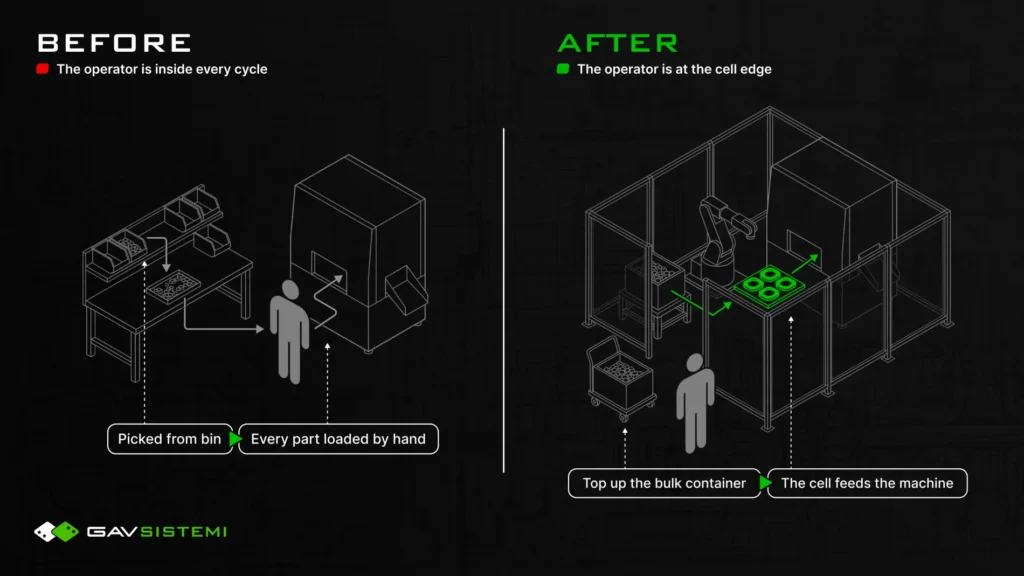
We have covered what a robotic island is elsewhere on this blog. A feeding cell is that concept applied to one specific job: keeping a process supplied with picked, oriented parts.
How the cell picks depends on how the parts arrive:
| How parts arrive | Typical pick | How orientation is handled |
|---|---|---|
| Trays, parts pre-registered | Robot picks from known tray positions | The tray holds orientation; a camera can verify it |
| Totes, loose small parts | Transfer into a feeder, or vision-guided pick | Feeder tooling sorts by geometry, or the camera locates each part |
| Floor containers, bulky parts | Vision-guided pick from the container | Regrip on a registration nest before presentation |
| Feeder outlet, small hardware | Robot or escapement at the outlet | Sorted mechanically inside the feeder |
How do parts get oriented before they reach the machine?
Two ways: mechanically, with tooling that only lets a part through the right way up, or by vision, with a camera locating each part so the robot adjusts its grip. Which one fits is a decision we make part by part, early in the project, and it rests on three properties of the component: geometry, surface, and fragility.
| Mechanical orientation | Vision-guided orientation | |
|---|---|---|
| How it works | Feeder tooling shaped so a part passes only in the correct attitude | Camera locates each part; the robot adapts its grip and path |
| Suits | Small hardware with stable, sortable geometry | Bulky, delicate, or variable parts straight from bulk |
| Part variants | New tooling when the geometry changes | New vision recipe and gripper details on the same cell |
| Failure mode to engineer out | Jams from tangled or deformed parts | Misreads from surface finish or lighting |
A worked example, using the hardest arrival format in the first table: bulky parts loose in a floor container. The camera looks into the container and selects a candidate the gripper can reach cleanly. The robot takes it with whatever grip the bulk allows, which is rarely the grip the process needs. It sets the part down on a registration nest and picks it up again from a known position. From the nest onward the part is located, and it stays located all the way to the machine. On paper that regrip looks like a wasted move. It is the move that turns a random bin into a repeatable presentation.
Can a robotic cell feed a machine you already own?
Yes. Feeding shows up in two forms in our work. When we build a custom automation machine, feeding is engineered into it from the start: we ask how the parts will arrive at the customer’s plant before the layout is drawn. An automated tightening station carries its own screw feeding, and on a rotary assembly machine the load station is designed around the arrival format.
The second form is tending: a robot station placed at an existing machine or line. That machine was built to receive parts from a human hand, so the cell’s job is to match the interface the hand used to serve: same presentation point, same orientation, at the pace the machine already runs. We have written before about integrating robotic cells into existing lines, and part loading is a natural place to start, because the machine itself stays untouched.
Is part feeding the same as part transport?
No, and the distinction matters when scoping a project. Feeding gets parts into a process: picked from bulk, oriented, presented to one operation. Transport moves work between operations: a line with pallet conveyors carries assemblies from station to station, each pallet keeping its part registered and traceable. A complete line often needs both, engineered separately, because they solve different problems. Feeding deals with the disorder of bulk. Transport deals with distance and sequencing between stations. When the two get merged in an early conversation, the scope usually comes out wrong on both sides.
When does feeding automation pay off?
When the handling around an operation outweighs the operation itself, and volume makes that ratio permanent. The signals are visible on the floor: operators reaching and walking more than assembling, output plans that call for more benches doing identical work, a downstream process sensitive to how the part is presented.
What the cell returns is stability. A robot picks and presents the same way every cycle, so the machine’s cycle time holds through the whole shift, every shift. Repeatable presentation protects the operation that follows, too: a tightening, a press-fit, or a camera check behaves better when the part shows up in the same position every time. In assembly automation this is often where a project starts. The value operation is already proven. Feeding is the part of the cycle that automation gives back.
Frequently asked questions
Does a feeding cell remove the operator?
It moves the operator. The residual task is replenishing bulk at the edge of the cell, swapping a container or topping up a feeder, on a schedule decoupled from the machine cycle. One person can cover that boundary alongside other work.
Can one feeding cell handle more than one part variant?
Yes, through changeover on the same base cell: grippers, registration nests, and vision recipes change with the part, while the robot and the cell structure stay. The variants have to be known when the cell is engineered, so the pick and orientation methods cover all of them.
What if parts arrive in completely random bulk?
That is the hardest feeding case, and it has two standard answers: vision-guided picking straight from the bin, or a feeder step that turns random bulk into an oriented stream. Which one fits depends on the part’s geometry, surface, and fragility, and it is a decision our engineers make part by part, early in the project.