
 Skip to content

A client assembled a product across four manual stations: screwdriving, pressing, inspection with labeling, and packing. Four operators carried the part between them. We rebuilt the process as one rotary indexing machine. The part is loaded once, every operation runs on the table, and it comes off labeled and packed.
This is the second build story in our case series, after the closed-loop winding line.
Two things changed on this line at the same time, and they are worth separating. The stations collapsed into one machine, which is the part you can see in a layout drawing. The checks that used to sit in an operator’s judgment became results the machine measures and keeps, which is the part you only see once the line is running. The second change is what makes the first one hold.
What did the manual line look like?
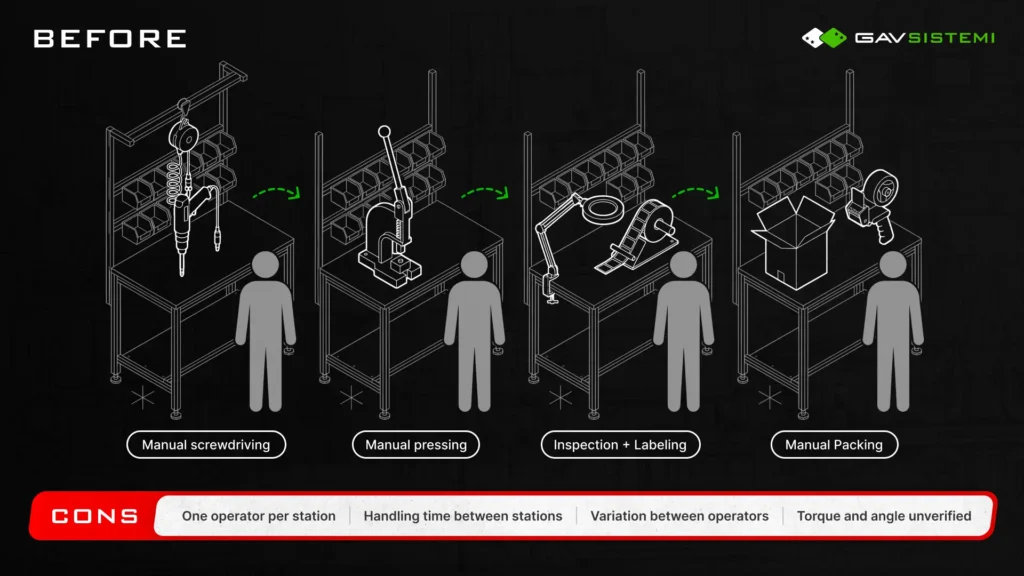
Four stations, four operators, one part traveling by hand. Screwdriving came first, at a manual bench. Then pressing, at the next station. At the third an operator inspected the assembled part and applied its label. At the fourth, finished parts were packed for shipment.
Lines like this run in every plant, and this one did its job. Its cost sat in the handovers. Between every pair of stations the part waited in a tray, got picked up, oriented, and set down again in a position the next operator had to read before starting work. Four people spent a share of every shift moving parts rather than working on them.
Look at where the inspection sat and the layout explains itself. The check came third, after screwdriving and pressing were both finished, and the same person who made that call applied the label. Anything that varied at the first two stations arrived at that bench together, in a part that was already complete. The operators were the process, and they held it steady with attention. The client called us to move the numbers.
How does one rotary table absorb four stations?
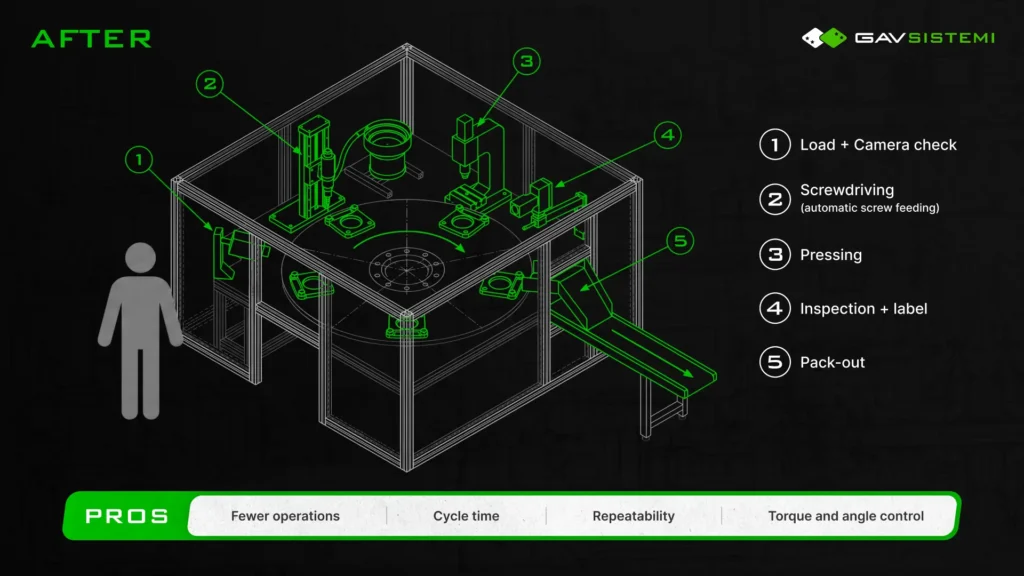
By arranging every operation around one indexed table, so the part travels machine-side instead of hand-to-hand. On the rotary indexing machine we built for this line, the sequence runs:
- Load, with a camera check. The operator seats the part in the fixture. A camera verifies every component is positioned correctly before the cycle starts.
- Screwdriving. Screws arrive through an automatic feeding system and the spindle tightens each joint with torque and angle monitored. How a torque-controlled screwdriving station is built, feeder to record, is a subject of its own.
- Pressing. Done on the table, in the same fixture the part was loaded into, so the press works to a part that has not moved since the screws went in.
- Inspection and labeling. The part is checked and the label applied automatically.
- Pack-out. At the unload station the part is packed and leaves the machine on a conveyor.
One operator runs the machine, loading and unloading.
The single load is what carries the rest of it. The part is located and clamped once, in a fixture built for that part, and every head that comes down afterwards works to the same datum. Nothing between screwdriving and pressing asks anyone to pick the part up, turn it, and read its position again. That is also why the values the machine records are worth comparing across parts: the joint is presented to the spindle the same way on every cycle, so a torque reading means the same thing on the first part of the shift and on the last.
| Step | Manual line | Rotary table |
|---|---|---|
| Screwdriving | Hand-held driver, operator-fed screws | Automatic screw feeding, torque and angle monitored on every joint |
| Pressing | Separate station, second handover | Press station on the table, same fixture |
| Inspection and label | Operator checks and applies the label at a bench | Camera check at load, label applied in the cycle |
| Packing | Manual, at the end of the line | Automatic pack-out at unload |
| Part handling | Carried between four stations | Loaded once, indexed through every station |
| Operators | Four, one per station | One, loading and unloading |
The rows follow the same order the stations did. The machine took the process over step by step, in the sequence the product already had.
Why does an indexed table move the numbers?
Because the stations stop taking turns. On the manual line each part collected the time of every operation plus every wait between them. On an indexed table all stations work at once: while one part is pressed, the next is screwdriven and a third is loaded. Cycle time is set by the slowest station rather than by the sum of them. The mechanics are covered in how a rotary indexing machine cuts cycle time; this line is what they look like in service.
Repeatability follows from the same geometry. Every part takes the same path through the same fixtures under the same heads, so every unit sees the same process, whichever shift produced it. On a hand line the sequence is remembered; on the table it is built into the layout.
On this line the headline outcome was people: four operators before, one after. Cycle time came down with the layout, and the checks that used to live in an operator’s hands became part of the machine cycle. The three moved together, because they come from the same change: the part stopped being carried.
What does the machine add to process control?
A result for every operation, on every part. Each joint is tightened under torque and angle control, so a screw outside its window is caught at the station, before the table indexes. The camera at load confirms the part is seated before any head touches it. The label is applied inside the cycle, downstream of inspection, the way an end-of-line station closes a process, so the label follows a check instead of standing in for one.
Where each check sits matters as much as the check itself:
| Check | Where it runs | What it catches |
|---|---|---|
| Camera on the loaded fixture | At load, before the cycle starts | A component missing or seated wrong, before any work is added to the part |
| Torque and angle, joint by joint | At the screwdriving station, before the table indexes | A joint that reached the wrong value, or reached the right value the wrong way |
| Inspection ahead of the label | On the table, before pack-out | A part that should leave the machine as non-conforming rather than labeled |
Teaching a camera routine is bench work, and it happens on our floor before the machine ships. Good parts alone are not enough to prove it: the vision check gets shown the failures too, a component left out, another seated proud, until it calls each of them the same way every time. That bench work is what decides whether a check earns its place in the cycle or turns into an alarm people learn to acknowledge and move past.
The operators on the old line worked with care. What the machine adds is what no bench can keep on its own: a stored, traceable result for every joint and every check, attached to the individual part rather than to the shift that made it.
When does consolidating a manual line make sense?
When the process is stable, the assembly operations fit around a table, and volumes keep the stations busy. Stability is the one worth testing first: a table is engineered around a sequence, so the sequence has to be settled before the layout is drawn.
A custom automation machine is built around one process. This table carries screwdriving, pressing, inspection and pack-out because that is the sequence this product needed, in that order, with the checks at the points where they were worth making. A different product with a different sequence gets a different table.
Whether the investment pays back is a calculation for each line, and the general case is covered in the ROI of moving from manual to automatic lines. This build is one real data point for it.
Frequently asked questions
Does one operator really run the whole process?
Yes. The operator loads parts, removes packed ones, and supervises the machine. Screw feeding, tightening, pressing, inspection, labeling and pack-out all run inside the cycle, so the work that is left is the work at the two ends of it.
What happens when a joint fails its torque or angle window?
The station flags the result and the part is handled as non-conforming before the table moves on. The point of catching it at the station is timing: the part is stopped where the fault was made, not at a bench three operations later. Every part that leaves the machine as good has passed every check on the table.
Can the table be adapted when the product changes?
Fixtures, heads and parameters change; the base machine stays. That is a machine changeover, and on our tables it is designed in from the first layout, because the interfaces that make a changeover quick have to be drawn before the first one is ever run.