
 Skip to content

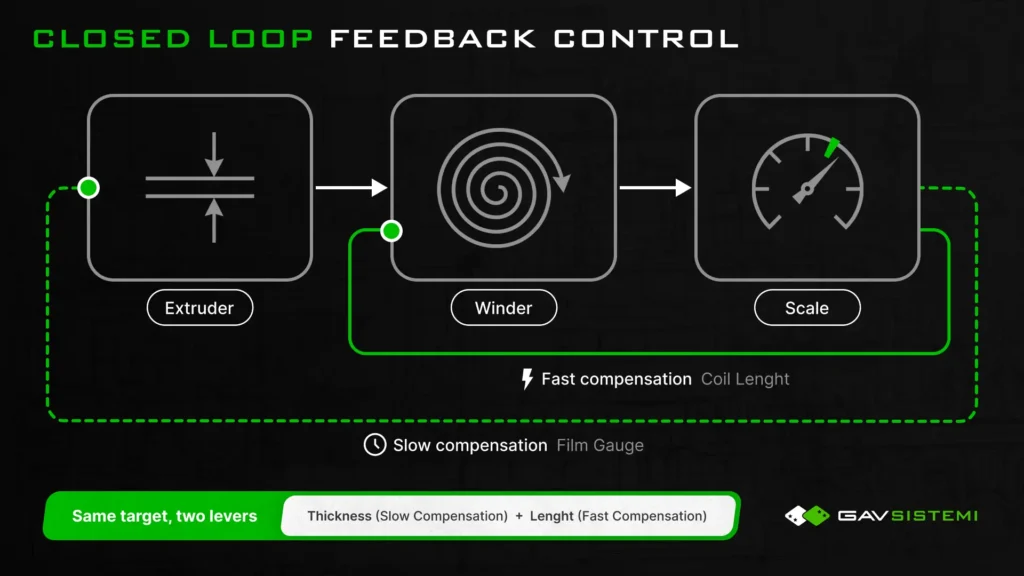
Machines run in closed loop when a measurement taken downstream adjusts process parameters upstream automatically, with no operator in between. On a film winding line, the end-of-line scale detects coils drifting above target weight, the extruder corrects the film gauge, and the winder compensates the coil length while that correction settles.
What does it mean for machines to run in closed loop?
It means the measurement acts on the process instead of only describing it. Every automated line measures something: weights, dimensions, torque values, test results. In most plants that data travels one way, into records, charts, and accept-or-reject decisions. That is real work, and it is the foundation everything else sits on. In a closed loop the same data also travels back. The measured value is compared with its target, the difference is turned into a correction, and the correction goes to a machine upstream, applied automatically, cycle after cycle.
The hardware on the measurement side is ordinary quality check equipment: a scale, a camera, a gauge, a tester. What changes is what happens in the seconds after the measurement, and that is a controls and integration question rather than a sensor question. A plant with good instrumentation is usually much closer to a working loop than it thinks.
How does the weight loop work on a winding line?
The case comes from a line we worked on: film wound into coils, each coil specified by weight. The scale at the end of the line weighs every finished coil, and when one comes in above target the line reacts in two directions at once.
The first message goes to the extruder: reduce the film gauge. An extruder will not change gauge on command. Gauge follows from melt conditions, screw speed, and line speed, and those take time to settle, while the material already in the line keeps arriving at the old thickness. The correction is the right one, and it is slow.
The second message covers the gap the first one leaves. It goes to the winder: trim the wound length slightly, so each coil stays inside its weight window while the thicker film works its way through. Length is the one variable on that line that can change from one coil to the next with no settling time, which is what makes it a good compensator. As the gauge comes back to nominal, the winder returns to the standard length and the compensation fades out by itself.
Two corrections at two speeds. The slow one removes the cause, the fast one protects the spec in the meantime. That pairing is the transferable part of this case. On most lines there is one parameter that fixes the problem and a different parameter that can hold the product in spec while the fix takes effect, and a loop built on the first one alone will keep shipping out-of-window product for as long as the actuator takes to respond.
| Signal | Measurement alone | Closed loop |
|---|---|---|
| Overweight coil | Flagged, then reworked or shipped as giveaway | Corrected upstream from the next coil |
| Process drift | Grows until someone reads the chart | Caught at the first out-of-window coil |
| Material use | Giveaway accumulates over the shift | Converges back to target |
| Operator | Chases parameters across machines | Supervises a line that corrects itself |
The giveaway row is the one that decides most business cases. A coil above target still satisfies the customer’s minimum, so it ships, and the extra material ships with it. Nobody files a complaint, no scrap report is opened, and the cost stays invisible until somebody reconciles material consumed against material sold at the end of the shift. A loop that pulls the process back toward target keeps that cost from accumulating in the first place.
What does it take to connect machines this way?
Three things, and all of them are controls engineering rather than new hardware.
| Requirement | What it means on the line | What it prevents |
|---|---|---|
| Measurement synced to the machine cycle | Every coil is weighed and attributed to the run window that produced it | Corrections computed against the wrong coil’s data, so the loop chases itself |
| Upstream controls open to external corrections | The parameter can be written from outside its own program, within a permitted range | Data that reaches the machine and stops at the display |
| Correction logic sized for the actuator | Small steps, with the loop waiting for the effect before it steps again | Overshoot, which turns a weight problem into an oscillation around target |
The third row is where these projects are won or lost. A loop that corrects hard and often looks impressive on a whiteboard and hunts around the target on a real line, because the actuator it drives has dead time the arithmetic did not account for. Sizing the step to the response of the machine, and clamping the range a correction is allowed to move within, is what separates a loop that runs unattended from one the operators end up switching off. The permitted range matters for a second reason: the operator has to be able to see what the loop changed and take the parameter back at any moment. A loop nobody can watch is a loop nobody trusts.
This is where a machine builder earns its keep. A custom automation machine is engineered around one process, and on a connected line the process spans machines. The same discipline that defines stations and cycle times inside a single machine extends to the interfaces between machines, from the processing stations to the measurement that closes the loop. The engineering work is in the interfaces: what each control system already exposes, what it has to be made to expose, and what the correction means in the units the receiving machine actually understands.
Is this Industry 4.0 in practice?
Yes, and it is the part of the label that pays for itself. We have covered Industry 4.0 in automation as a roadmap on this blog. This case is the destination. Most lines already collect this data, and the step that changes the economics is letting the data act.
It is also a cheaper step than it sounds, because the spending sits in engineering hours rather than in machines. The scale is already there. The controls are already there. What gets built is the path between them and the logic that decides how far to move.
The loop protects the rhythm of the line as well. Drift gets handled inside the cycle, so the production flow carries on while the correction happens, with no stop for a manual adjustment and no batch of coils sitting on hold while somebody decides what to change.
Frequently asked questions
Can existing machines be connected in closed loop?
Often, yes. Two conditions decide it: a measurement worth acting on, and controls that expose the right parameter for writing rather than for reading only. Machines from different makers and different generations can join the same loop once those interfaces are engineered. Establishing what each control system already exposes is the first step of the project, and it comes before anyone specifies hardware.
What measurements can drive a closed loop?
Any value measured in line that has an upstream parameter to act on: weight, dimensions, torque, leak rate, vision results. What the loop needs is a stable relationship between the two, so that a parameter change has a predictable effect on the measured value. Where that relationship is well understood, the loop is straightforward controls work. Where it shifts with material batch or ambient conditions, the loop steps more slowly and gives the process room to settle before it corrects again.
Does closed-loop control replace final inspection?
No. The loop runs on the inspection data, so end-of-line checks stay exactly where they are, and the loop makes their findings rarer. Inspection tells you where the process is; the loop is what the line does about it. The record stays too: every coil is still weighed and logged, and closing the loop adds the correction that followed to that record, so a drift can be read back later together with the response it triggered.