
 Skip to content


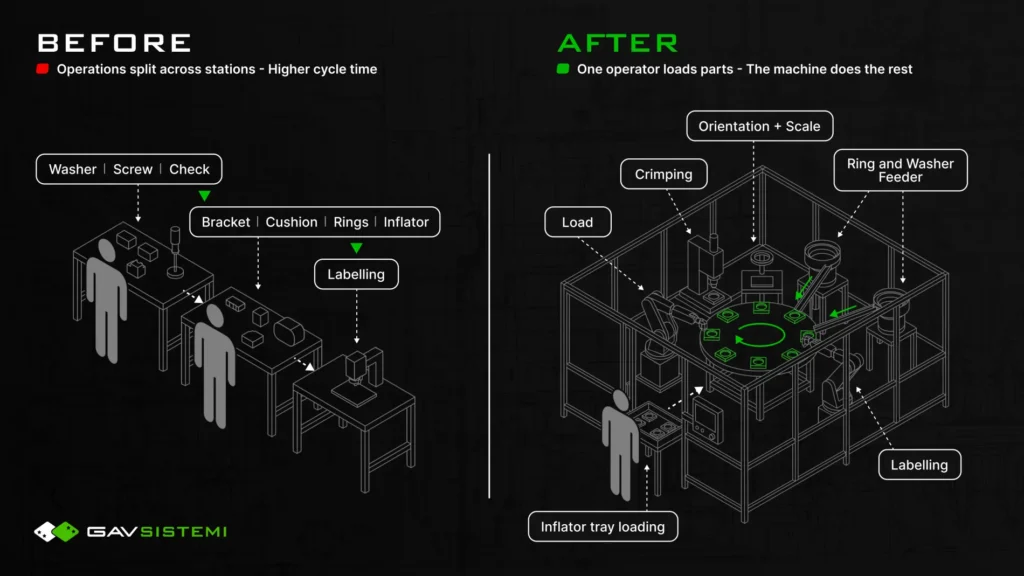
An airbag module joins a cushion, an inflator, two retaining rings, a bracket, a washer and a screw. We automated that assembly in three stages: manual benches first, then operations split across two semi-automatic machines, then one rotary machine with two robots and a single operator, cycling at roughly 18 to 20 seconds per part.
Most automation stories jump straight from manual to machine. This process took the longer road, and the road is worth telling. Each stage earned the next one: the benches showed where the labor was really going, the split machines showed which cycle would set the pace, and the final machine was designed around both answers. On a safety component built in the millions per year, that sequence is how the risk stays managed while the volumes climb.
What does airbag module assembly involve when it is done by hand?
Seven components per module, and an operator who has to fetch, orient and place every one of them. The cushion comes out of a large container beside the bench. The rings, the bracket, the washer and the screw come from totes. The inflator has to be oriented before the rings are crimped around it, and on a manual bench the crimping is a manual operation too.
Watch that bench for a shift and a pattern shows up: half the work is reaching for parts and turning them the right way around. Only half is assembly. The operator’s trained judgment goes into a fraction of each cycle; the rest of it, that person is the feeding system. It is the same pattern we see across assembly automation projects, and it gets expensive at volume, because one bench holds one operator’s pace. Hitting a high-volume takt means multiplying benches, and every added bench duplicates the full set of operations, crimping included. The most skill-sensitive step in the process gets copied along with everything else, once per bench, each copy with its own hands and its own habits.
Why split the operations across two semi-automatic machines?
Because splitting is the correct engineering answer when full automation is still a step away. The operations were divided by content: one machine handled the washer, the screw and a check; the second handled the bracket, the cushion and both rings. Labeling ran on its own bench. Two operators replaced a row of duplicated benches, each machine took over part of the precision work, and the process gained its first real structure. Crimping moved onto a machine at this stage, which took the most sensitive operation out of individual hands well before the final machine existed.
The split also made the next constraint visible, which is what a good intermediate stage does. The two cycle times never balanced. The washer-and-screw side ran fast; the bracket-and-cushion side ran slow, because that operator still had to fetch and orient the bulkiest components. When two coupled stations run at different speeds, the slow one sets the output of both. From there, the case for one machine wrote itself: the imbalance had a name, component fetching, and a machine that feeds itself removes it.
How does one rotary machine run the whole assembly?
The machine is built around a rotary indexing table, with the process arranged as stations around it. Ring 1, ring 2 and the washer arrive from feeders. A second, smaller indexing table stages the bracket. The inflators are loaded onto trays, and a pick axis carries them into the cycle. Two robots handle the moves between stations. The part passes an orientation and weighing station, the rings are crimped in cycle, and the finished module is labeled before it leaves the machine.
One operator runs it, and the job is loading inflator trays. Every other component feeds itself. Look at what that did to the old imbalance: the bulky components that made one semi-automatic machine slow are now presented by feeders, trays and the small indexing table, so fetching time dropped out of the cycle entirely. The target cycle is around 18 to 20 seconds per part, and the table works its stations in parallel. While one module is being crimped, the next is being weighed and the one behind it is being loaded. The pace holds regardless of which component used to be the slow one to fetch.
| Manual benches | Two semi-automatic machines | One rotary machine | |
|---|---|---|---|
| Operators | One per bench, benches multiplied to hold rate | One per machine, plus separate labeling | One, loading inflators |
| Component handling | Operator fetches and orients every part | Operator loads each machine’s component set | Feeders, trays and robots orient and place |
| Crimping | Manual, at the bench | On-machine | In-cycle station |
| Labeling | Separate step | Separate bench | In cycle, before unload |
| Cycle behavior | Set by operator pace | Unbalanced between the two machines | Stable, ~18–20 s per part |
The rows read as a history of where the work went. Handling moved from hands to feeders, crimping moved from the bench to a station, and labeling moved from its own bench into the cycle.
We have told a rotary consolidation story before, in our case study on replacing four manual stations with one table. That project was about absorbing separate stations and adding process control on every joint. This one is about a process that evolved in stages as its volumes grew, and about what the last stage looks like when the part is a safety component.
Why does repeatability decide at millions of parts a year?
Because at that volume the question is no longer how fast a good operator can work. It is whether cycle ten thousand looks exactly like cycle one. A skilled operator crimps well; the machine crimps the same way, at the same speed and the same pressure, every single cycle, and the time is stable. On a safety part built in the millions per year, that sameness is the specification. In this industry, process defects carry consequences far beyond a scrap bin, and the companies buying these modules qualify their suppliers on exactly this point.
Airbag work is familiar ground in our workshop. We build airbag folder machines for the folding side of the same product, and our overview of automotive automation covers the broader shift in the sector, airbag assembly included. What a purpose-built machine adds to that shift is specificity: the repeatability is designed around one module, its seven components and its takt, which is the core of how we approach every custom-built machine.
Can one machine build four product variants?
Yes. This machine runs four product variants for different end customers on the same base. The process is identical across the four; the rings and the washer are common parts, while the inflators, the cushions and the brackets differ. The devices that handle them are the same, so the four families were consolidated onto one machine instead of four. What changes between variants, and what stays, follows the logic we described in our article on machine changeover; we will come back to this machine’s four-family setup in its own right.
The same base-machine thinking is what let a heavy-part assembly machine convert between two product diameters as contracts alternated. Designed in from the first layout, variant capability is what keeps a custom machine earning after its first product moves on.
Frequently asked questions
Why does the operator load only the inflators?
The inflators are the one component the process brings in on trays, through a dedicated loading step, with a pick axis carrying them into the cycle. Rings and washers arrive from feeders, and the bracket is staged on its own small indexing table, so no other component needs a person to present it. The operator keeps trays coming; the machine does the rest.
How does the machine verify orientation?
Every module passes a dedicated orientation and weighing station before crimping. Orientation is checked by the machine rather than trusted to the way a part was picked, which on a manual bench was one of the main sources of variability.
Does a new variant mean a new machine?
Here it did not: four variants share the base machine because they share the process and the handling devices. When a variant falls outside what the devices cover, the changeover is engineered, and the base machine, its table and its controls stay.